What Zepbound is
Zepbound is the brand name for tirzepatide, made by Eli Lilly. It acts on two gut-hormone receptors, GIP and GLP-1 (Zepbound label, FDA, 2026). The US label approves it, together with a reduced-calorie diet and more physical activity, for two uses (Zepbound label, FDA, 2026):
- To reduce excess body weight and keep it off long term, in adults with obesity, or adults with overweight and at least one weight-related condition.
- To treat moderate to severe obstructive sleep apnea in adults with obesity.
It comes as single-dose pens, single-dose vials, multi-dose vials and KwikPens (Zepbound label, FDA, 2026). The label says not to use it with other tirzepatide products or any other GLP-1 medicine (Zepbound label, FDA, 2026). Mounjaro is the same medicine, approved in the US for type 2 diabetes (Mounjaro US label, FDA, 2026).
The label has a boxed warning about thyroid C-cell tumors, which were seen in rats. It isn't known whether this happens in people. Don't use Zepbound if you or a family member has had medullary thyroid carcinoma, or if you have MEN 2 (Zepbound label, FDA, 2026).
How the dose steps up
The US Zepbound label gives one schedule for adults, for weight management and for sleep apnea: a starting dose of 2.5 mg once a week for 4 weeks, which it says is not a maintenance dose, then 5 mg. The label says the dose may be increased in 2.5 mg steps after at least 4 weeks on the current dose, taking response and tolerability into account. For weight, its maintenance doses are 5, 10 or 15 mg. For sleep apnea, they are 10 or 15 mg. The maximum is 15 mg a week (Zepbound label, FDA, 2026). Zepbound is approved for adults only. Mounjaro, the type 2 diabetes brand, has its own label, which steps the dose up only if more blood sugar control is needed and sets a 10 mg maximum for children aged 10 and over (Mounjaro US label, FDA, 2026). Your prescriber decides your dose.
| Weekly dose | Earliest start | What the label calls it |
|---|---|---|
| 2.5 mg | Week 1 | Starting dose, for 4 weeks. Not approved as a maintenance dose |
| 5 mg | Week 5 | Maintenance dose |
| 7.5 mg | After at least 4 weeks on 5 mg | A step between doses |
| 10 mg | After at least 4 weeks on 7.5 mg | Maintenance dose (weight and sleep apnea) |
| 12.5 mg | After at least 4 weeks on 10 mg | A step between doses |
| 15 mg | After at least 4 weeks on 12.5 mg | Maintenance dose (weight and sleep apnea). The maximum |
The adult schedule from the US Zepbound label (Zepbound label, FDA, 2026). Each step is 2.5 mg, at least 4 weeks apart. Many people stay on a dose for longer or never go up to 15 mg. Your prescriber decides your dose.
What changes, and when
The main weight trial was SURMOUNT-1. It gave 2,539 adults without diabetes tirzepatide or a placebo for 72 weeks, with diet and activity counseling for everyone (SURMOUNT-1, NEJM, 2022).
At 72 weeks, average weight change was −15.0% on 5 mg, −19.5% on 10 mg, −20.9% on 15 mg and −3.1% on placebo (SURMOUNT-1, NEJM, 2022). Results varied a lot. On 15 mg, 90.9% lost at least 5% of their weight and 56.7% lost at least 20% (SURMOUNT-1, NEJM, 2022).
- Tirzepatide 5 mg
- Tirzepatide 10 mg
- Tirzepatide 15 mg
- Placebo
The chart follows the Zepbound label's figure. It and the paper's headline count people who stopped treatment differently, so their numbers differ slightly. Digitised from Figure 3 (SURMOUNT-1) of the Zepbound US label, one marker at a time. At week 4 the three dose markers sit almost on top of each other. At week 8 the 10 mg marker is hidden behind the others, so that point is left out. (Zepbound label, FDA, 2026). Points are read off the published chart, so they can be out by about a quarter of a percentage point. They are average results in the trial, not a prediction. Your results will differ.
Show the numbers
| Week | Tirzepatide 5 mg | Tirzepatide 10 mg | Tirzepatide 15 mg | Placebo |
|---|---|---|---|---|
| 4 | −3.3% | −3.3% | −3.2% | −1.1% |
| 8 | −6.0% | Not readable from the published figure | −5.9% | −1.8% |
| 12 | −7.9% | −8.9% | −8.4% | −2.1% |
| 16 | −9.2% | −11.1% | −10.6% | −2.4% |
| 20 | −10.5% | −12.8% | −12.6% | −2.6% |
| 24 | −11.6% | −14.2% | −14.6% | −2.9% |
| 36 | −13.7% | −17.3% | −18.2% | −3.3% |
| 48 | −15.0% | −19.1% | −20.2% | −3.2% |
| 60 | −16.0% | −20.6% | −21.6% | −3.4% |
| 72 | −16.1% | −20.9% | −22.0% | −3.3% |
Weight came off fastest in the first months, then slowed. The paper says the 5 mg group reached a plateau by week 72 and the higher doses were close to one (SURMOUNT-1, NEJM, 2022). For each month, see Zepbound week by week.
Most common side effects
The label lists the side effects reported by at least 5% of people on Zepbound: nausea, diarrhea, vomiting, constipation, stomach (abdominal) pain, indigestion, injection site reactions, tiredness, allergic (hypersensitivity) reactions, burping, hair loss and acid reflux (GERD) (Zepbound label, FDA, 2026).
In SURMOUNT-1, stomach side effects were mostly mild to moderate and happened mainly while the dose was going up (SURMOUNT-1, NEJM, 2022). The label also covers serious risks, including pancreatitis and gallbladder problems. For pancreatitis, the label tells people to stop Zepbound and contact their healthcare provider if they get severe stomach pain that may spread to the back, with or without vomiting (Zepbound label, FDA, 2026).
What to track beyond weight
Weight is one number, and it moves for lots of reasons. The trials also measured waist size. In SURMOUNT-1, the average waist shrank by 14.0 cm on 5 mg, 17.7 cm on 10 mg and 18.5 cm on 15 mg, against 4.0 cm on placebo (SURMOUNT-1, NEJM, 2022). That's about 5.5, 7.0 and 7.3 inches.
A short record makes appointments easier. You can tell your prescriber what happened, not what you remember.
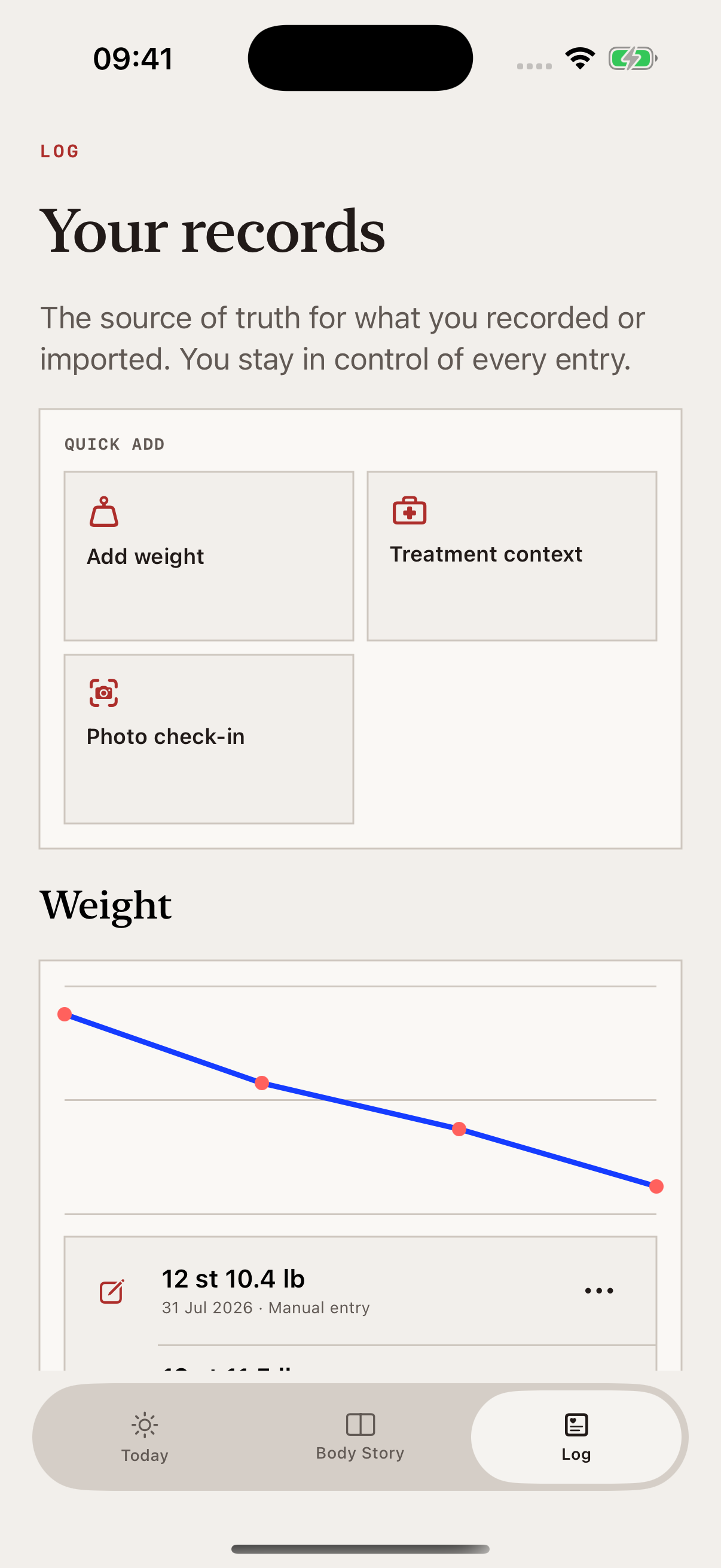
- Weight, at the same time of day, read as a weekly trend rather than a daily verdict.
- Waist, measured the same way each time: midway between your lowest rib and the top of your hip bone, after breathing out normally (NICE NG246, 2025).
- Photos from the same four angles, in the same light and clothes.
- Each shot: the date, the dose, where you injected and any reaction.
- Side effects, appetite and how you feel, on the day they happen.
- Protein and strength training, because part of the weight lost is lean mass (why it matters).
Before your next shot.
- Write down your dose and shot day
- Log side effects when they happen
- Weigh in on the same day each week
- Measure your waist the same way
- Take photos in the same light
- Take questions to your prescriber
Where these facts come from.
- NDA 217806 (Zepbound) approval history: original approval 8 Nov 2023. Drugs@FDA.
- FDA approves first medication for obstructive sleep apnea. FDA news release, 20 Dec 2024.
- ZEPBOUND (tirzepatide) US prescribing information, Eli Lilly. Revised 8/2026. DailyMed.
- MOUNJARO (tirzepatide) US prescribing information, Eli Lilly. Revised 8/2026. DailyMed.
- Jastreboff AM et al. Tirzepatide once weekly for the treatment of obesity. N Engl J Med 2022;387:205-216.
- Overweight and obesity management. NICE guideline NG246: identifying and assessing overweight, obesity and central adiposity. Published 14 Jan 2025.
Checked 25 Oct 2026. Trial figures are average results in the trial, not predictions. Labels change; your prescriber and the leaflet in your pack have the current version.
Pip Body Scan is a personal progress record. It is not a medical device and does not give medical advice, diagnose conditions or recommend doses. Speak to your prescriber or another qualified healthcare professional about symptoms, side effects or changes to your treatment.