What Mounjaro is
Mounjaro is the brand name for tirzepatide, made by Eli Lilly. It acts on two gut-hormone receptors, GIP and GLP-1 (Mounjaro SmPC, MHRA, 2026). In the UK it comes as a KwikPen you use once a week.
The UK label licenses it for two things (Mounjaro SmPC, MHRA, 2026):
- Type 2 diabetes, in adults and children aged 10 and over, alongside diet and exercise.
- Weight management, including weight loss and keeping it off, in adults with a BMI of 30 or more, or a BMI of 27 to 30 with at least one weight-related condition such as high blood pressure, sleep apnoea or type 2 diabetes. It is used alongside a reduced-calorie diet and more activity.
The MHRA authorised it for weight management on 8 November 2023 (MHRA, 2023). In the US, the same medicine is sold as Mounjaro for type 2 diabetes and as Zepbound for weight (Mounjaro US label, FDA, 2026) (Zepbound label, FDA, 2026).
Getting Mounjaro on the NHS or privately
NICE recommends tirzepatide on the NHS for adults with a BMI of at least 35 and at least one weight-related condition (NICE TA1026, 2024). The BMI threshold is usually 2.5 lower for people of South Asian, Chinese, other Asian, Middle Eastern, Black African or African-Caribbean background (NICE TA1026, 2024).
GP prescribing is being phased in. From 23 June 2025 the first group was people with a BMI of 40 or more and at least four of these: high blood pressure, abnormal blood fats, obstructive sleep apnoea, heart disease and type 2 diabetes. The second group, in 2026/27, is people with a BMI of 35 to 39.9 and four or more of them (NHS England, 2026).
You can also get Mounjaro on a private prescription. The MHRA says to get weight-loss medicines only from a registered pharmacy with a valid prescription (MHRA, 2026), and warns against buying them from beauty salons or social media (MHRA, 2026).
If you have lost less than 5% of your starting weight after 6 months on the highest dose you can tolerate, NICE says a decision is needed about whether to carry on (NICE TA1026, 2024). That decision is one for you and your prescriber.
How the dose steps up
Section 4.2 of the UK label gives one schedule for adults, for type 2 diabetes and for weight management: a starting dose of 2.5 mg once a week for 4 weeks, then 5 mg. If needed, the dose can be increased in 2.5 mg steps after at least 4 weeks on the current dose. The label's maintenance doses are 5, 10 and 15 mg, and its maximum is 15 mg a week (Mounjaro SmPC, MHRA, 2026). For children and young people aged 10 and over with type 2 diabetes, the label's maximum is 10 mg a week (Mounjaro SmPC, MHRA, 2026). The table shows the adult schedule.
The US Mounjaro label is for type 2 diabetes, not weight management. It gives a starting dose of 2.5 mg once a week and says to increase in 2.5 mg steps, after at least 4 weeks on the current dose, if additional glycaemic control is needed. Its maximum is 15 mg a week for adults and 10 mg for children aged 10 and over (Mounjaro US label, FDA, 2026). Your prescriber decides your dose.
| Weekly dose | Earliest start | What the label calls it |
|---|---|---|
| 2.5 mg | Week 1 | Starting dose, for 4 weeks |
| 5 mg | Week 5 | Maintenance dose |
| 7.5 mg | After at least 4 weeks on 5 mg | A step between doses |
| 10 mg | After at least 4 weeks on 7.5 mg | Maintenance dose |
| 12.5 mg | After at least 4 weeks on 10 mg | A step between doses |
| 15 mg | After at least 4 weeks on 12.5 mg | Maintenance dose. The maximum |
The adult schedule from section 4.2 of the UK label (Mounjaro SmPC, MHRA, 2026). Each step is 2.5 mg, at least 4 weeks apart. Many people stay on a dose for longer or never go up to 15 mg. Your prescriber decides your dose.
If you miss a jab, the UK label says to take it within 4 days. If more than 4 days have passed, skip it and take the next one on your usual day (Mounjaro SmPC, MHRA, 2026).
What changes, and when
The main weight trial was SURMOUNT-1. It gave 2,539 adults without diabetes tirzepatide or a placebo for 72 weeks, with diet and activity counselling for everyone (SURMOUNT-1, NEJM, 2022).
At 72 weeks, average weight change was −15.0% on 5 mg, −19.5% on 10 mg, −20.9% on 15 mg and −3.1% on placebo (SURMOUNT-1, NEJM, 2022). Results varied a lot. On 15 mg, 90.9% lost at least 5% of their weight and 56.7% lost at least 20% (SURMOUNT-1, NEJM, 2022).
- Tirzepatide 5 mg
- Tirzepatide 10 mg
- Tirzepatide 15 mg
- Placebo
The chart follows the US label's figure. It and the paper's headline count people who stopped treatment differently, so their numbers differ slightly. Digitised from Figure 3 (SURMOUNT-1) of the Zepbound US label, one marker at a time. At week 4 the three dose markers sit almost on top of each other. At week 8 the 10 mg marker is hidden behind the others, so that point is left out. (Zepbound label, FDA, 2026). Points are read off the published chart, so they can be out by about a quarter of a percentage point. They are average results in the trial, not a prediction. Your results will differ.
Show the numbers
| Week | Tirzepatide 5 mg | Tirzepatide 10 mg | Tirzepatide 15 mg | Placebo |
|---|---|---|---|---|
| 4 | −3.3% | −3.3% | −3.2% | −1.1% |
| 8 | −6.0% | Not readable from the published figure | −5.9% | −1.8% |
| 12 | −7.9% | −8.9% | −8.4% | −2.1% |
| 16 | −9.2% | −11.1% | −10.6% | −2.4% |
| 20 | −10.5% | −12.8% | −12.6% | −2.6% |
| 24 | −11.6% | −14.2% | −14.6% | −2.9% |
| 36 | −13.7% | −17.3% | −18.2% | −3.3% |
| 48 | −15.0% | −19.1% | −20.2% | −3.2% |
| 60 | −16.0% | −20.6% | −21.6% | −3.4% |
| 72 | −16.1% | −20.9% | −22.0% | −3.3% |
Weight came off fastest in the first months, then slowed. The paper says the 5 mg group reached a plateau by week 72 and the higher doses were close to one (SURMOUNT-1, NEJM, 2022). For each month, see Mounjaro week by week.
Common side effects
The UK label lists these as very common, which means more than 1 in 10 people: feeling sick, diarrhoea, being sick, constipation, stomach pain, less appetite and tiredness. Low blood sugar is very common when Mounjaro is taken with a sulphonylurea or insulin (Mounjaro SmPC, MHRA, 2026).
Common ones, up to 1 in 10 people, include indigestion, bloating, burping, wind, reflux, dizziness, hair loss, gallstones and reactions where you inject (Mounjaro SmPC, MHRA, 2026). In SURMOUNT-1, stomach side effects were mostly mild to moderate and happened mainly while the dose was going up (SURMOUNT-1, NEJM, 2022).
Acute pancreatitis is a rare but serious risk. The MHRA strengthened its warnings for all GLP-1 medicines in January 2026 (MHRA Drug Safety Update, 2026). The NHS page lists the serious side effects and when to get urgent help (NHS, 2026).
Mounjaro may make the contraceptive pill less effective in people who are overweight. The MHRA advises adding a non-oral method, especially for 4 weeks after starting and after each dose increase (MHRA, 2025). Stop at least a month before trying to get pregnant (Mounjaro SmPC, MHRA, 2026).
What to track beyond weight
Weight is one number, and it moves for lots of reasons. The trials also measured waist size. In STEP 1, the average waist shrank by 13.5 cm on semaglutide 2.4 mg and 4.1 cm on placebo (STEP 1, NEJM, 2021). In SURMOUNT-1 it shrank by 14.0 to 18.5 cm on tirzepatide, depending on dose (SURMOUNT-1, NEJM, 2022).
A short record makes appointments easier. You can tell your prescriber what happened, not what you remember.
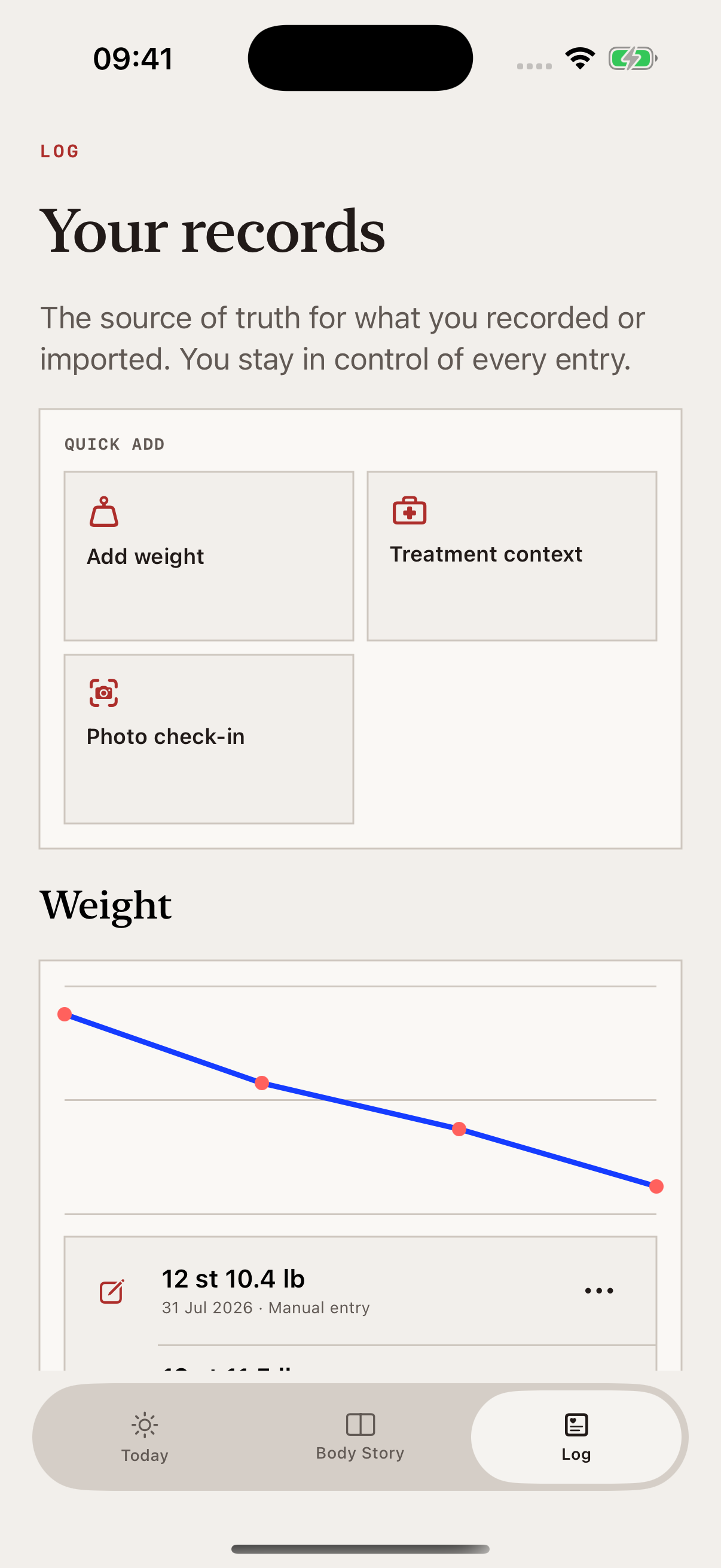
- Weight, at the same time of day, read as a weekly trend rather than a daily verdict.
- Waist, measured the same way each time: midway between your lowest rib and the top of your hip bone, after breathing out naturally (NICE NG246, 2025).
- Photos from the same four angles, in the same light and clothes.
- Each jab: the date, the dose, where you injected and any reaction.
- Side effects, appetite and how you feel, on the day they happen.
- Protein and strength training, because part of the weight lost is lean mass (why it matters).
Before your next jab.
- Write down your dose and jab day
- Log side effects when they happen
- Weigh in on the same day each week
- Measure your waist the same way
- Take photos in the same light
- Take questions to your prescriber
Where these facts come from.
- Mounjaro KwikPen (tirzepatide) Summary of Product Characteristics. Revised 29 Aug 2026. emc.
- MHRA authorises diabetes drug Mounjaro (tirzepatide) for weight management and weight loss. 8 Nov 2023.
- MOUNJARO (tirzepatide) US prescribing information, Eli Lilly. Revised 8/2026. DailyMed.
- ZEPBOUND (tirzepatide) US prescribing information, Eli Lilly. Revised 8/2026. DailyMed.
- Tirzepatide for managing overweight and obesity. NICE technology appraisal guidance TA1026. Published 23 Dec 2024, updated 1 Sep 2025.
- Interim commissioning guidance for NICE TA1026 (tirzepatide). Updated 2 Apr 2026.
- Counterfeit weight loss pens worth £2 million seized by MHRA and West Midlands Police. 15 Oct 2026.
- GLP-1 medicines for weight loss and diabetes: what you need to know. Updated 5 Feb 2026.
- Jastreboff AM et al. Tirzepatide once weekly for the treatment of obesity. N Engl J Med 2022;387:205-216.
- GLP-1 receptor agonists and dual GLP-1/GIP receptor agonists: strengthened warnings on acute pancreatitis. 29 Jan 2026.
- Tirzepatide. NHS medicines information. Last reviewed 15 May 2026.
- Women on 'skinny jabs' must use effective contraception, MHRA urges in latest guidance. 5 Jun 2025.
- Wilding JPH et al. Once-weekly semaglutide in adults with overweight or obesity. N Engl J Med 2021;384:989-1002.
- Overweight and obesity management. NICE guideline NG246: identifying and assessing overweight, obesity and central adiposity. Published 14 Jan 2025.
Checked 25 Oct 2026. Trial figures are average results in the trial, not predictions. Labels change; your prescriber and the leaflet in your pack have the current version.
Pip Body Scan is a personal progress record. It is not a medical device and does not give medical advice, diagnose conditions or recommend doses. Speak to your prescriber or another qualified healthcare professional about symptoms, side effects or changes to your treatment.